
"Seize the Day"
"When I dare to be powerful, to use my strength in the service of my vision,
then it becomes less and less important whether I am afraid."
-Audre Lorde
Learning to Fly
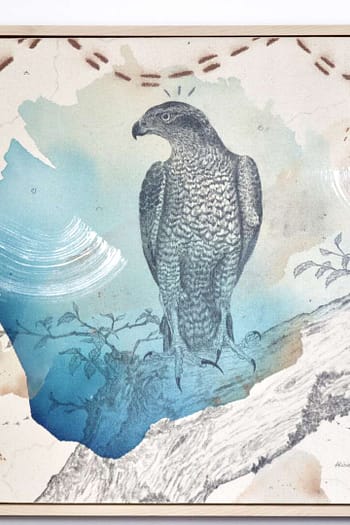
As though stepping out of a dark room and out into noonday sunlight, this series was almost a 180-degree turn with cognitive whiplash and G-force. Before any research, I knew the energy of this work was akin to that moment you lift off in an aircraft, your stomach doing a little somersault.
It's also personal. I was obsessed with the power of flight in high school, dreaming of becoming a pilot. I still remember dreams of running as fast as I could on the sidewalk to get airborne for a few precious seconds, or I backed a mini personal aircraft the size of a van out of our driveway and took off. I joined the Civil Air Patrol as a sophomore and learned about aerospace, search and rescue, and leadership--and that I could hardly stomach a 4-seater plane, let alone a jet. Alas.
The messages and lessons from these creatures of the skies have been filling my spiritual lungs. They don't ask you if you're ready; it's time to leap off that perch and test your wings.
They are here to teach us not just how to fly, but to soar, maintain a higher perspective, clarity of vision, and keen awareness.
When the sky is the limit, what can you do? Where will you go? What will you dream and bring into form?


Now for an aerial dive into the kaleidoscope history of these masters of the wind and sky. Similar to the owls, diurnal raptors have been both revered and feared for millennia; however, the day raptors have the advantage of greater visibility, inspiring awe as they soar, hunt, and build huge nests. While the owls ecologically traded speed for stealth in the night, day raptors have honed their acuity, agility, and speed. They are true experts in 'going after it'--hence their namesake, raptor, from the Latin rapere, 'to seize.' And with sharp talons, beaks, and eyesight, they do!
Of all avian groups, birds of prey have continued to shape our cultural landscapes and life ways for millennia. They are more than apex predators; they are a shaping and balancing force in their respective ecosystems, which we share.
These are masters of the wind and rulers of the sky's expanse, with aerial dynamism and power.
From aviation to falconry, companion hunting and gathering to shamanic connection and ceremony, our fates have been intertwined. Our relationship with these birds is multifaceted, oscillating between predator-prey dynamics, cultural reverence, anthropogenic threats, and a unique partnership. While humans have exerted a significant influence on raptor evolution and population dynamics, understanding the historical context and promoting responsible interactions are crucial for ensuring the continued coexistence of these remarkable birds and human societies.
Myth & Folklore
Raptors have been recognized as key intermediaries between the earth and sky/heavens, associated with the sun and his journey/masculine vitality, and as protective companions even into the afterlife.
A few basic themes emerged:
- Power, strength, and nobility/kingship
- Vision, foresight, spiritual connection
- Protection and guardianship
- Transformation, change, shapeshifting
- Omens
In ancient Egyptian lore, hawks and falcons were venerated with ceremony. Hawks were celestial guardians who flew alongside Ra, the sun god, and falcons were associated with kingship, divine power, and protection. Horus, the god of sky and war, was depicted with a falcon head and human body.
North American First Nations peoples have viewed eagles as sacred for millennia, associated with healing, spiritual ascent, and protection. The Thunderbird was a supernatural being of power and strength, said to create thunder by flapping his wings, with petroglyph depictions that date back 4,000 years. Hawks are viewed as messengers, bringing insight, focus, and discernment.
Falcons are predominantly esteemed in Northern European history. Freya, the goddess of love, fertility and war, wore a cloak made of falcon feathers to shapeshift and travel between worlds. Yggdrasil, the Norse World Tree, features an eagle perched on top with a hawk on his head (right). The hawk may be a conveyor of knowledge between realms, and both serve as sentinels of the cosmos.
The Greco-Romans viewed eagles as symbols of power, authority, and strength. Eagles and hawks carried divine messages to the people, and hawks forewarned of coming events, such as to the Trojans of the Greek invasion.


Falconry
Falconry dates back thousands of years to ancient Egypt and the Asian steppes. There is even evidence of human-raptor relationships coinciding with migratory routes of prehistoric hunter-gatherer/forager groups.
Falconry has been practiced on every continent except Antarctica and has evolved with human sociopolitical, commercial, and ethnospiritual facets of life. Raptors have been companion hunters, for survival and sport, an marker of high social status or nobility, and part of the commercial fabric of village communities.
Today, falconry associations around the world are harbingers of ethical stewardship and care of these birds, conservationists, and preservers of this living world heritage. Falconers tend to their raptors every single day, forming a unique bond. Peregrine falcons, the traditional birds of falconry, were once endangered due to DDT. Falconers helped bring them back from the brink.
There is a sense of being close to the wilderness, both the raptors and land on which the falconers hunt with them, and a desire to communicate with these birds. The daily tending, hunting and tracking call for all senses on board--and reminds us of the need for ecological balance in the greater web of life.
Aviation
It does not take much to imagine how birds, especially raptors, inspired the human power of flight. The Wright brothers and other early flight researchers (da Vinci, anyone?) studied birds to understand how they achieved flight. They observed how hawks soared on wind currents and realized the curved shape of their wings generated lift--an early understanding of flight dynamics and aerospace engineering.
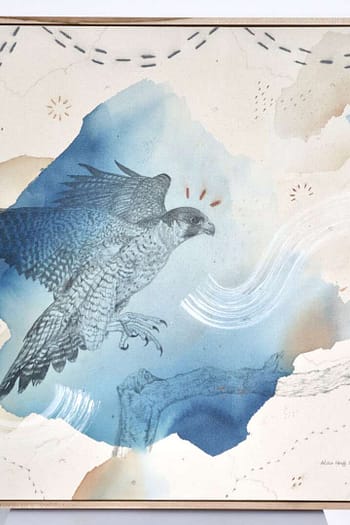
Known for their agility, speed, and precision in flight, raptors inspired the development of control mechanisms in early aircraft. Researchers today still draw inspiration from raptor flight dynamics in aircraft design. The Peregrine falcon specifically inspired modern-day jets--every aspect of the Peregrine is designed for agile, high-speed flight.


Questions that come to the forefront with these intersecting histories:
What does true ecological balance and reciprocity look like?
How do we honor these beings as teachers, elders, partners, and community members?
What does right use of power look like?
Riding the Thermals: Story Behind the Process

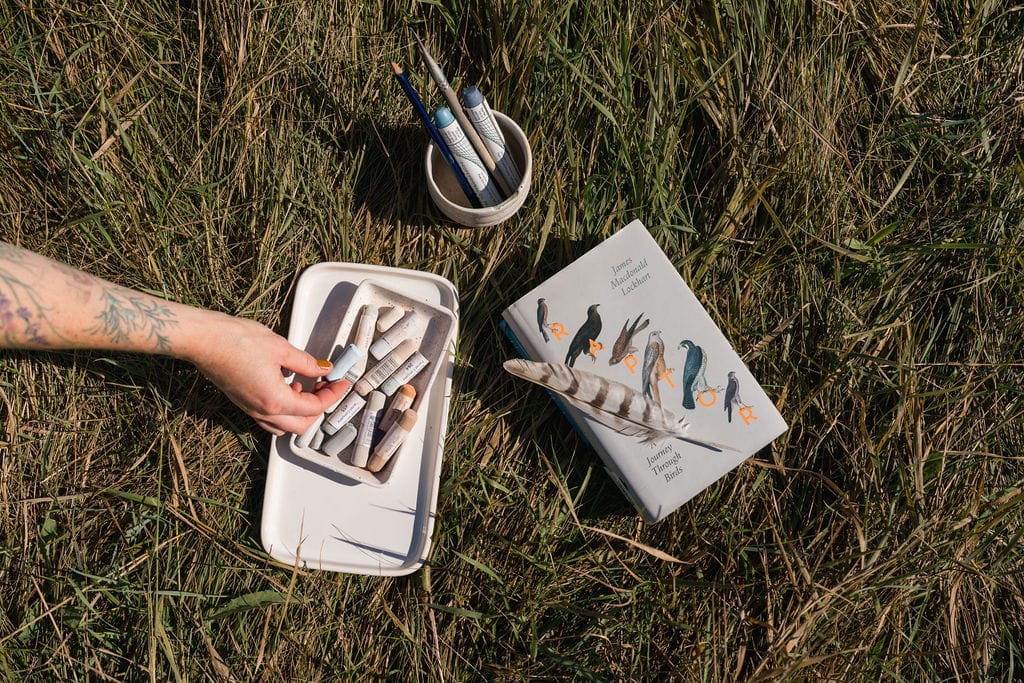
As with all my series work, substantial research was involved. There were so many angles with this one! I thrifted books, read many articles, and even took most of the 'Raptor ID' course with Cornell Lab of Ornithology.
But the best research for this series happened when I simply looked up and out. On a walk with Louie, our Aussiedoodle pup, I encountered a Merlin chasing a songbird--right into a brick house. He flew to the top of the lamppost nearby, and I blurted, "ARE YOU OKAY?!" and he stared at me for a full 1.5 seconds before chasing again. And of all years (or maybe just because I'm paying attention?), we have had an Osprey fishing in the nearby golf course pond this whole summer, riding thermals above our cul de sac. I wave and say hello.
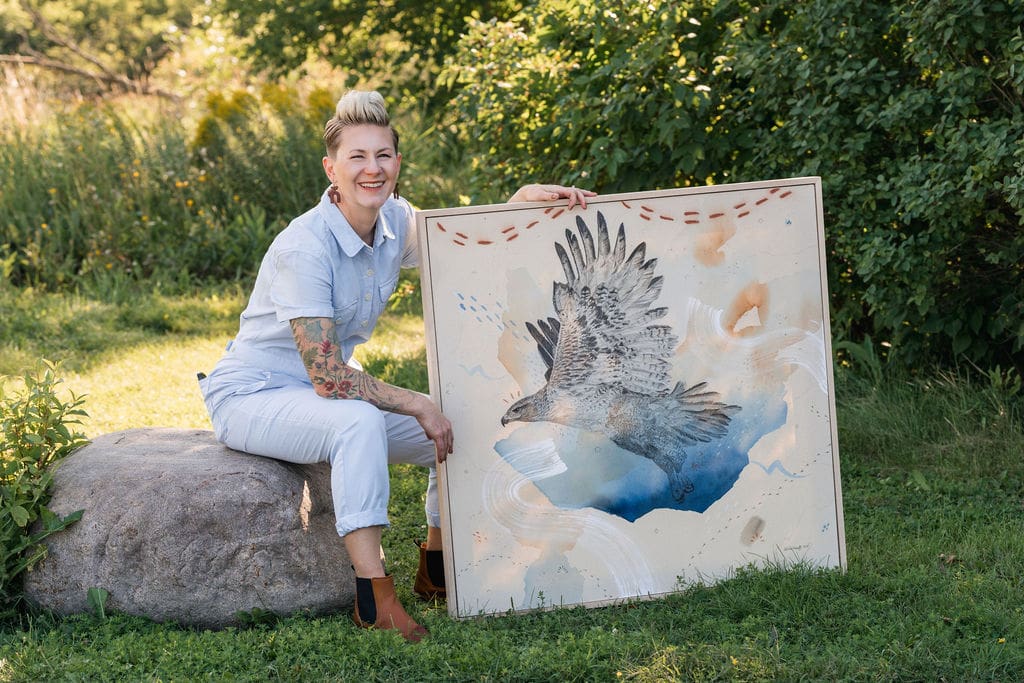
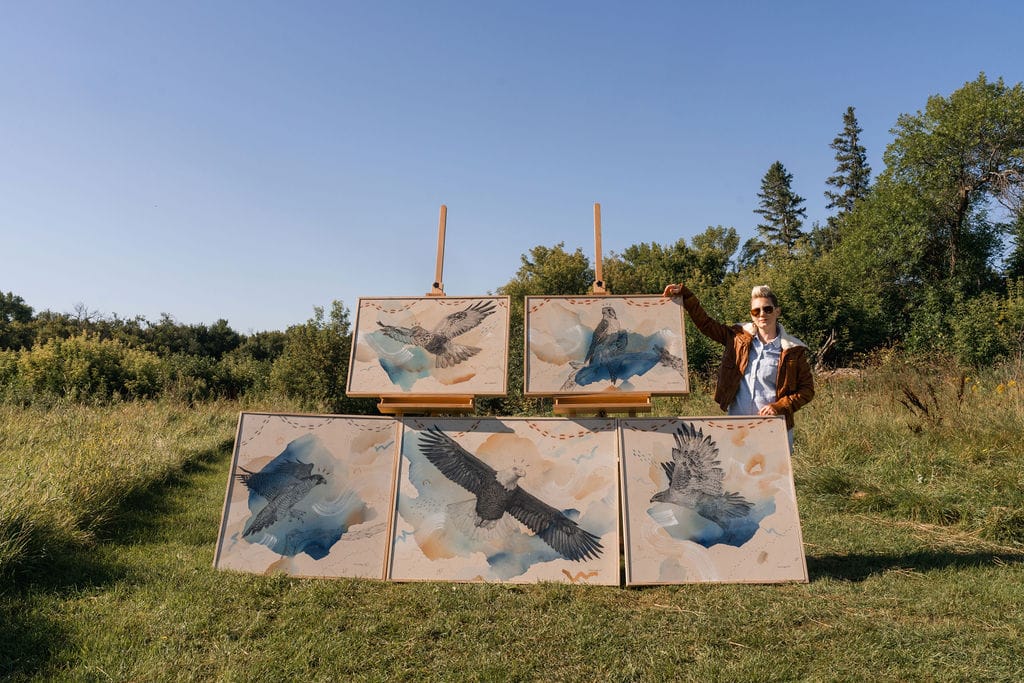
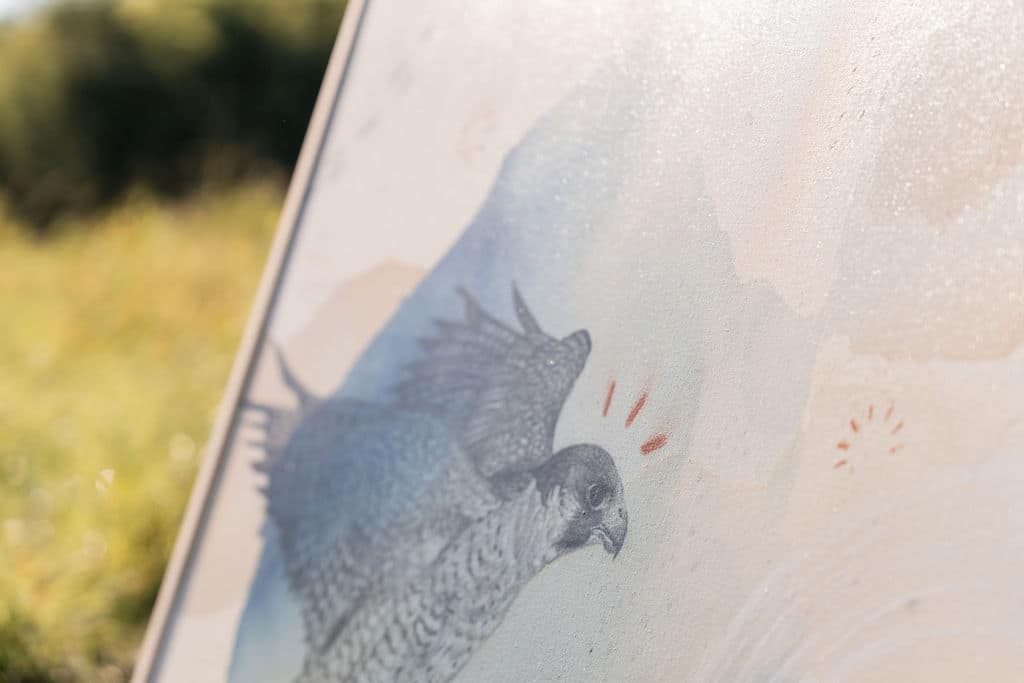
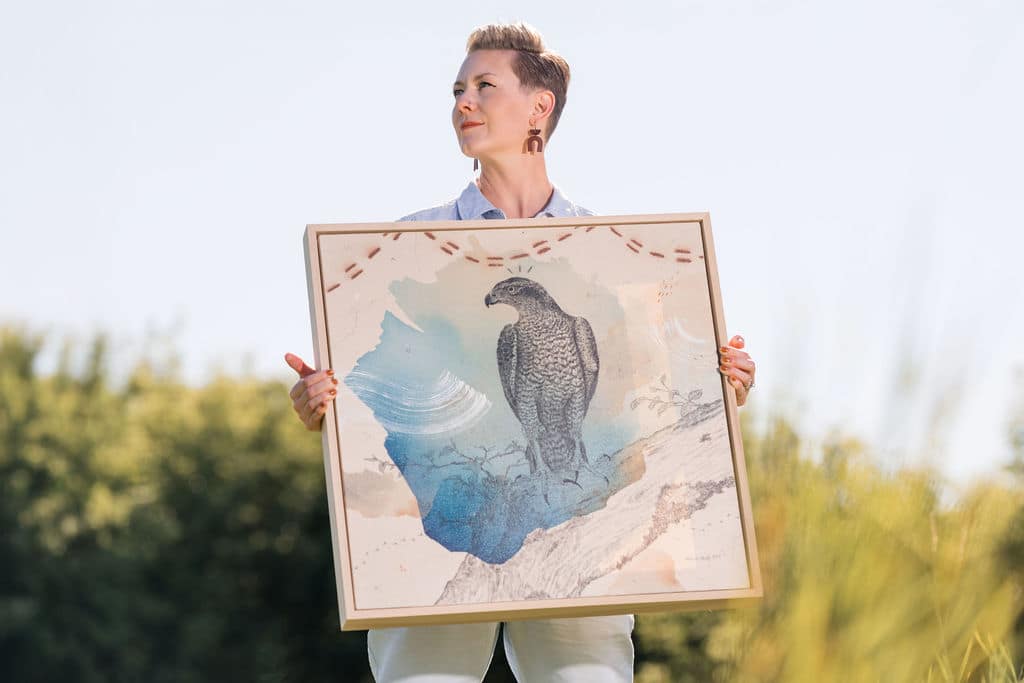
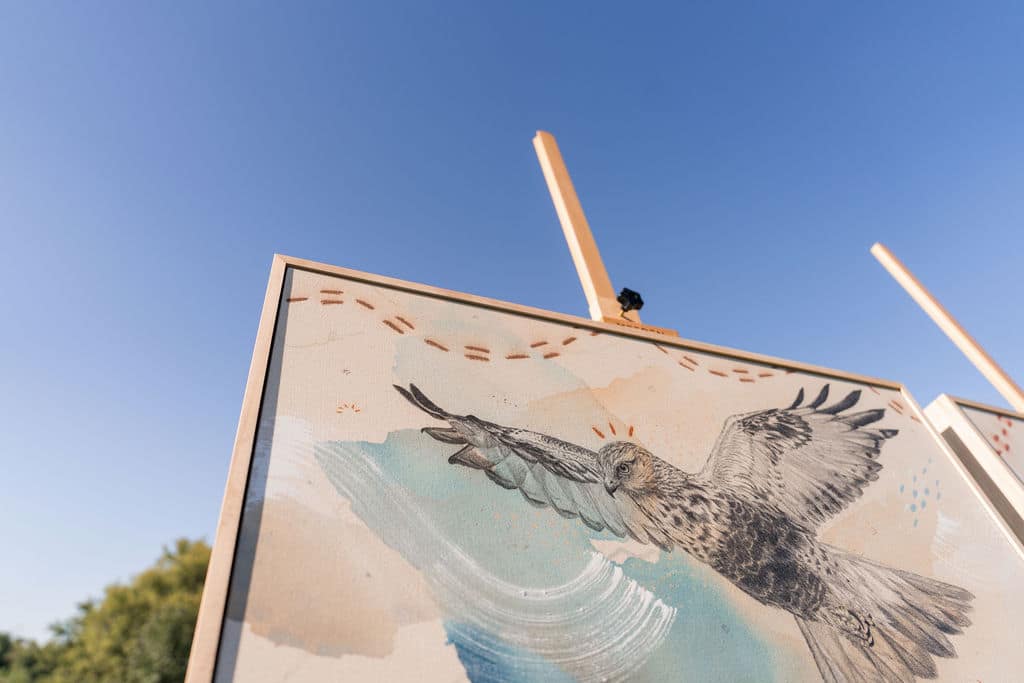
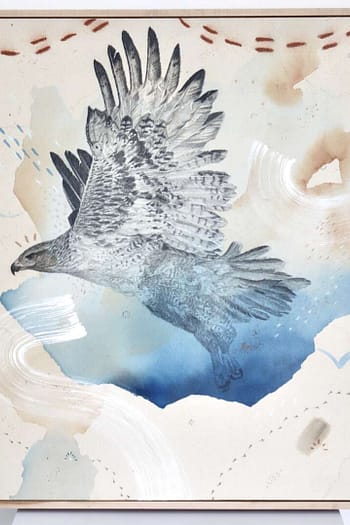
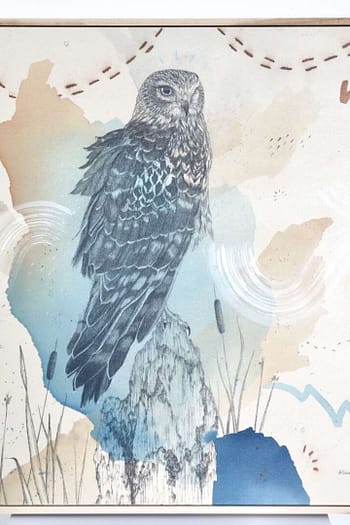
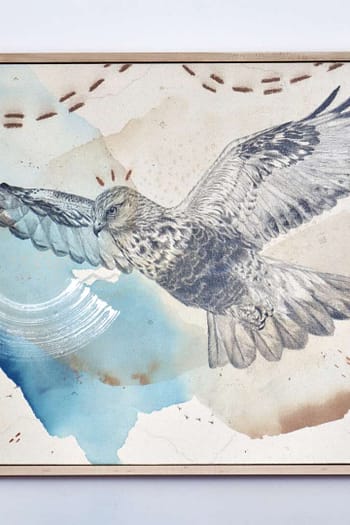
The color palette was chosen to capture the sky's expanse, wind, and air, and just a punch of complementary color.
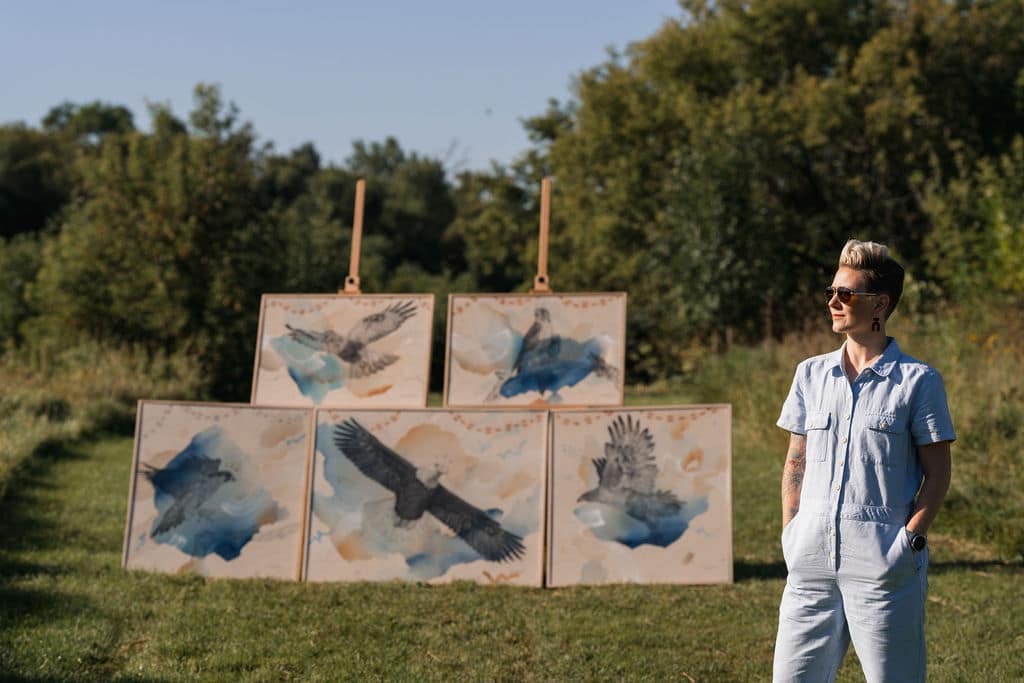
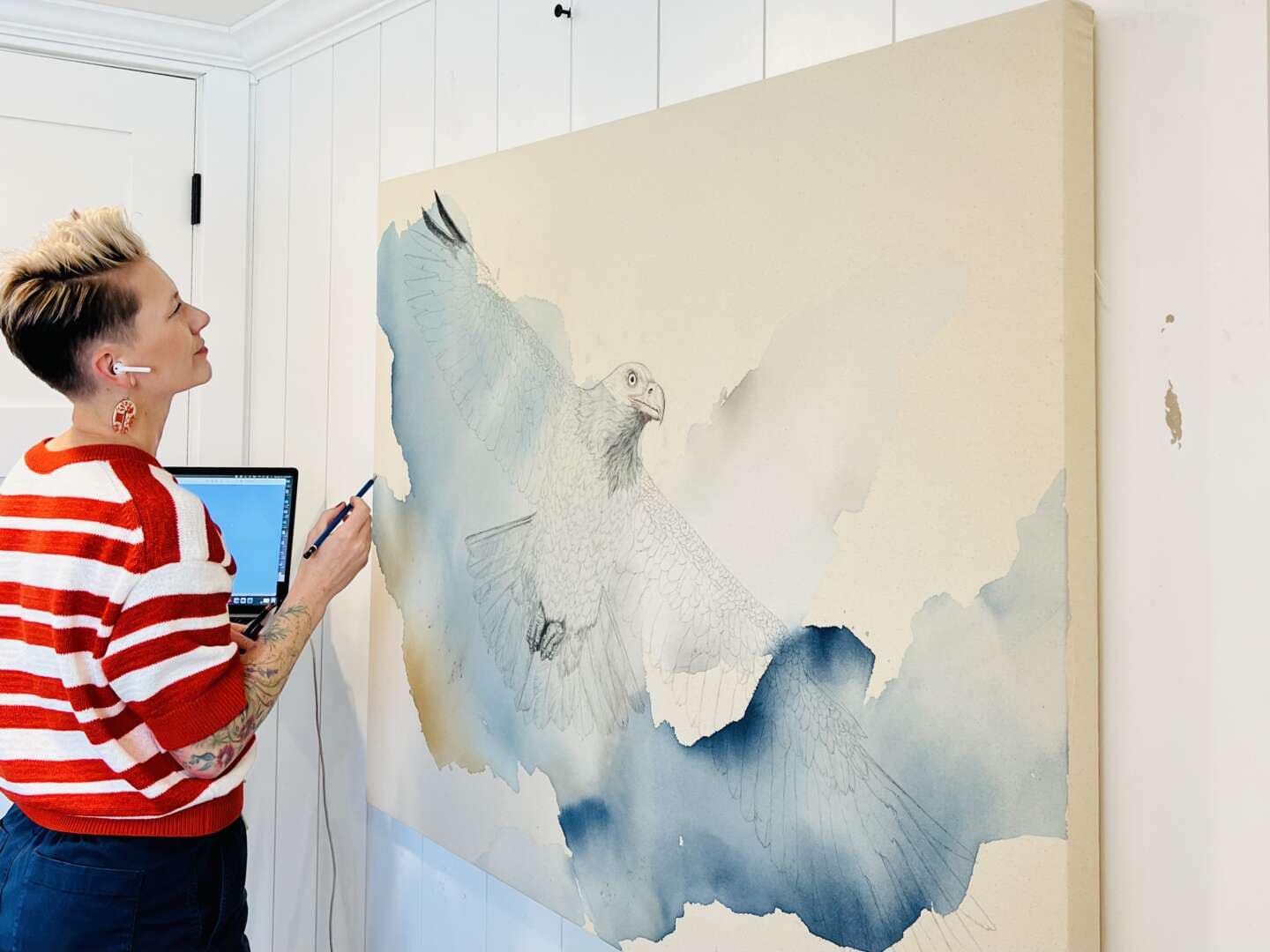
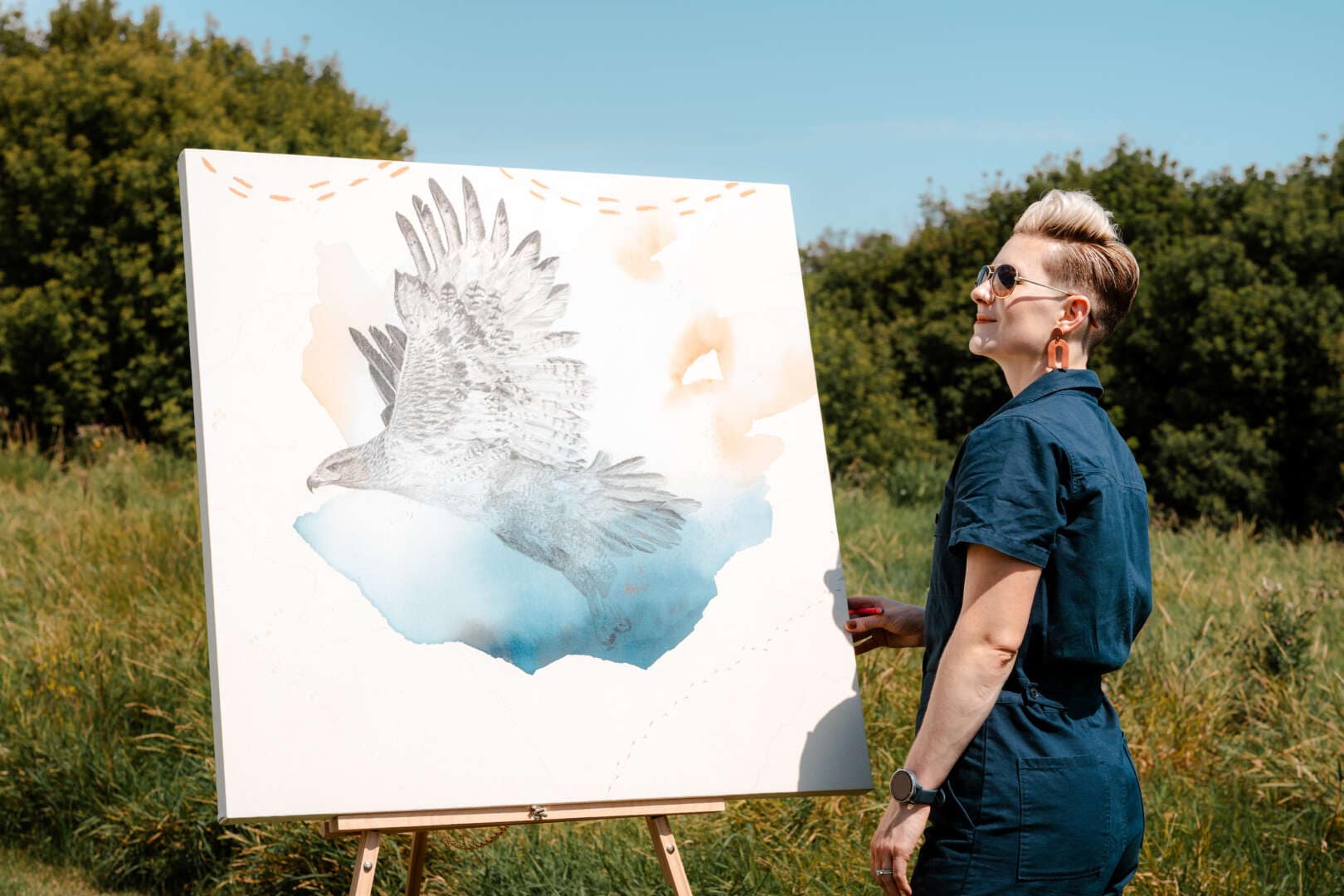
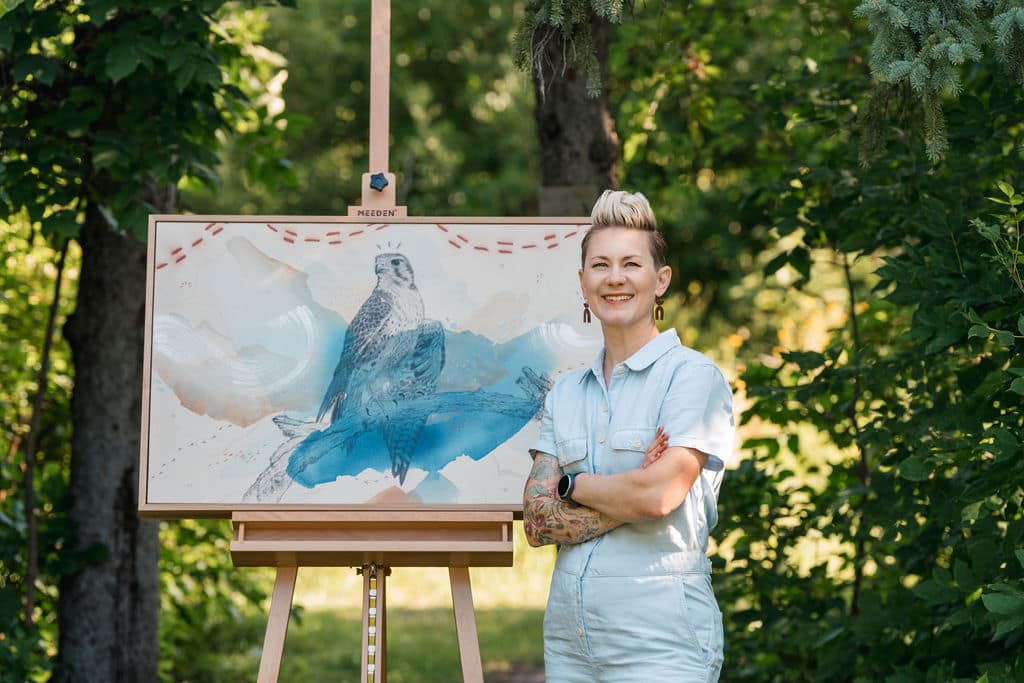
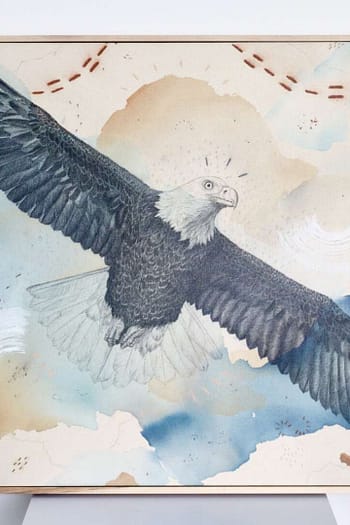
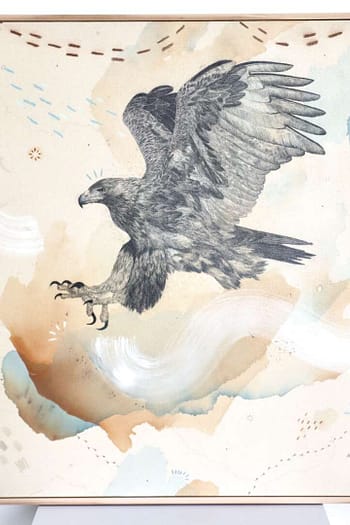
Once again, this series stretched my drawing skills and focus: more of the largest drawings I've ever done on canvas. I mean, a Bald Eagle can't be tiny, you know?
I worked steadily to complete each one and was very picky about reference photos. I drew a lot at home as I work in spurts between family obligations. I have come to realize every drawing is a meditation, a devotional, to the subject.
The videography and photography are always additionally phenomenal works of art for each series! I worked with Nick Deraney of True North Media once again to capture the energy of this series. As much as we plan for weather and other factors, it always comes together more beautifully than we imagine. Britta Trygstad of BTP (Britta the Photographer) and I met on a dewy morning in the same location in late August with the most azure of skies. Once we get in place, we literally seize the creative opportunity to play and showcase what we do.
The messages from these day raptors are clear:
Take the shot. Do the thing. Keep your wings level, and you'll soar.


“Be fearless in the pursuit of what sets your soul on fire.”
~unknown
- All
- Uncategorized
- Art
- Art media
- Gift Card
- Home/Office
- Original painting
- Studio Sale














Thank you for being here!
Video and Photography Credit