

Every autumn, the familiar dread seeps into daily conversations.
“The Farmer’s Almanac says it’s gonna be a cold one for sure, lots of snow.”
“If we get blizzards in April again, I’m leaving.”
“I need to move where the air doesn’t hurt my face.”
Or, if you’re a ‘snowbird,’ you opt out of winter for a few months of the year and hope it spans the coldest temps.
At some point growing up in the upper Midwest, I learned that winter was something to get through, filled with drudgery. That it was hard and, frankly, unacceptable. The uncertainty of what kind of winter we would deal with is likely half the misery. But here’s the kicker: the ones who complain about winter will inevitably gripe about rain, wind, and heat later.
To even consider that winter can be a beautiful season all its own is an affront to the cultural pastime of griping about the hardship. But what if we considered the industrial, psychological and cultural ways we make it hard? What if we remembered how to winter, and live according to natural rhythms?
What if we moved from resistance and denial to a place of greater attunement, flow, and alignment—and joy?
On the Clock
As elder millennials, my husband and I joke about being the ‘last analog generation.” Get a group of millennials together, and we could spout for hours about landlines, playing hide-and-seek until the streetlamps went on, riding our bikes to the local gas station for candy cigarettes and other goodies, and climbing trees to write in secret diaries. Dial-up internet alone has been the subject of comedic routines, and I love to joke about running outside with corded headphones and an anti-skip CD player in hand.
Nostalgia aside, the rate at which technology has advanced in the past few decades is head-spinning—and with negative effects on how we feel, connect, and sleep. A host of devices run our lives, telling us what we need to know, who’s doing what every second of the day, what’s coming and when, buzzing and dinging and shining with a brightness that assaults our corneas.
In this post-industrial capitalist society, time is money, productivity is value. And ‘if you’re on time you’re late.’ Like the white rabbit from Alice in Wonderland, we constantly move to the next thing, watching the clock. Activities. Appointments. Socials. Meetings. Phone calls. Emails. Our attention is demanded before we can think about what we want or need to tend to at the moment, nevermind the dishes, laundry, cooking and cleaning to do.
Hans Gelter writes in Nature First: Outdoor Life the Friluftsliv Way, “In addition to being flooded with information, speed has become the icon of our time, determining both our behaviors and consumption patterns. All our technological development is oriented towards increasing speed and ‘saving time,’ resulting in an ever increasing quickening of the pace of life.”
What does real rest mean to us these days? To hop off the hamster wheel? We’ve been conditioned to keep going, keep moving, keep working, keep reacting.
But literally slowing down gives us the opportunity to let ourselves catch up with ourselves, to integrate and notice things. To breathe.
We’ve forgotten how to winter.
Winter is the season that calls for us to slow down. Snow blankets and dampens sound. The cold pushes us inward. The ice forces us to be mindful of our tread and proceed with full senses on board. The dark alters our circadian rhythm and hormones shift—all signals to our mammal selves to conserve energy.
We can hate this and suffer, or we can choose to embrace its medicine. Real power comes with moving with natural cycles and seasons instead of pushing against it.
We can see winter as a time to rest more, reflect, review, and process. Take our energy back in as the plants all around us do. To regenerate. To let yourself rest more, and do less.
Katherine May speaks to this in her book, “Wintering: The Power of Rest and Retreat in Difficult Times, saying “There is not enough night left for us. We have lost our true instincts for darkness, its invitation to spend some time in the proximity of our dreams. Our personal winters are so often accompanied by insomnia: perhaps we’re drawn towards that unique space of intimacy and contemplation, darkness and silence, without really knowing what we’re seeking. Perhaps, after all, we are being urged towards our own comfort…Over and again, we find that winter offers us liminal spaces to inhabit. Yet still we refuse them. The work of the cold season is to learn to welcome them.”

Reflecting on the night often brings up a complex mix of emotions. Darkness can evoke feelings of both serenity and profound fear, with the “fear of night” often stemming from the unknown, the lack of visual clarity, and the heightened sense of vulnerability it can bring. Uncertainty itself is enough to grapple with these days.
What if we viewed darkness, night, as an invitation to quiet spaciousness? Like a blanket, let it wrap us up and hold us and our dreams?
Outside our doors, the natural world we’ve lost touch with but crave connection to can teach us how to winter. Outside our doors, the natural world waits for us to realize that world is also within.
We Are Earthlings
I’ve spoken before about how the stories we tell shape our worldview and our perception of place—and in Western culture, ‘nature’ is the monolith of a passive backdrop or stage where human things unfold, a place to go.
At some point, as geology professor Marcia Bjornerud laments in Kinship: Volume 1, “Western society stopped seeing the Earth as full of wisdom…and demoted it to dumb matter that we can easily outwit. I suspect this began in the early days of Christianity, when the church set out to purge every vestige of nature worship from the poplulations it sought to convert. Old pantheons that were deeply embedded in the landscape were replaced by an abstract, nonlocalized God and theology that depicted this world as an imperfect, temporary dwelling place…Earthly matter was corrupt, defiled. It is telling that mundane—meaning literally “of the earth”—is a pejorative.”
To remember we are of the earth, we are nature and ecosystems, is the foundation of a field I’m just becoming acquainted with: ecopsychology. But I’m not here to intellectualize our relationship with the earth; I’m here to remind us to embody that relationship.
Ailey Jolie, a psychotherapist and somatics specialist, outlines this beautifully: “Our nervous system is not separate from the planet—it is an extension of it…Just as the body knows rhythm, season, and repair, so does the land. The problem is, we have built a world that severs the body from both itself and the more-than-human world. Modern life has conditioned us into extraction—of resources, of energy, of labor. We push past exhaustion like a factory pushing past capacity. We value productivity over presence, output over organic cycles. But the body, like the Earth, is not a machine. It is a living system. It needs slowness, seasonality, restoration…The moment we remember that our bodies are part of the living world, we remember how to listen—to the body’s need for pauses, to the Earth’s need for care. We remember that the same nervous system that craves stillness is wired for connection, not just to people, but to place. And in that remembering, healing begins.”
To be of the earth, an earthling, is to remember the iron that flows in our blood is also in earth’s geological striae or river rock we find. The water within is just visiting, shared with fellow rivers and ponds. The oxygen we breath is exhaled by the trees and plants. The minerals in our earth bodies are all around us; we are walking landscapes. We are as much geology and weather pattern as we are human. After all, human is close to humus, the root “hum” (h-YOOM) means “ground,” of earth.
Human ego is out of balance with the rest of Earth, to say the very least.

And though winter is a season outside our walls, it is also a season for ourselves that comes and goes—be it illness, injury, grief, loss, or other challenge that asks us to go inward. To moderate, listen, and put one foot in front of the other slowly.
Even the experience of remembering this way of life, a way our ancestors knew and practiced—working with the land intimately, honoring and even extolling the land spirits and seasonal cycles—is its own form of grief to move through. I know this because I’m still moving through it. But I have never felt more grounded in who I am on this earth.
And there’s a concept for everything I’ve described so far, a way of living that hails from my Nordic ancestors: friluftsliv.
Open-Air Life
Whether it was one of the many calls from my ancestors to change or utter wit’s end, I had had enough. I was one of the upper-Midwesterners who bemoaned winter for many years, joining the cranky chorus of others at work as I ran my numb, white digits under hot water to regain circulation. I took my Raynaud’s alone as a sign I wasn’t meant to live here. And yet, here I was.
But something ‘had to give’ about five years ago. It was one of those “if I can’t beat it, I gotta join it somehow.” I really needed to understand why I was allowing the weather to dictate my disposition and outlook—mostly self-imposed limitations. This was still years before the concept frilufsliv entered my ecosystem. In hindsight, it was a part of me all along—the need to be outside as much as possible, studying everything around me, and relating to plants and animals in a heart-centered way. Like an ancestral gift waiting to be noticed.
Friluftsliv, pronounced “FREE-loofts-leev,” is the Nordic concept of “fresh-air life” or “open-air life,” with a central focus of relationship and deeper connection with natural landscapes. The Norwegian government defines it as “possibility of recreation, rejuvenation and restoring balance among living things.” It is often as simple as daily walks in the neighborhood (bonus points if it’s blizzarding a little and you don your thickest layers or snow suit to get out there) or as major as a backpacking trip somewhere in the wilderness. A key component: it is slow, intentional, and allows for a depth of connection and presence, especially over time and through the seasons. To embrace going outside on a day of ‘inclement’ weather is to say to the landscape, “I still want to spend time with you, and this is where I am today.”
As Linda Åkeson McGurk writes in her book The Open-Air Life: Discover the Nordic Art of Friluftsliv and Embrace Nature Every Day, “It’s about embracing simplicity, resisting consumerism, and living in a way that is sustainable to both ourselves and the planet. It’s the kind of life that transcends generations and connects us deeply with the land that sustains us. And it is in every respect a rich life.”
This looks like:
-
Getting to know the local plants and wildlife and their stories
-
Spending time outside every day, no matter the weather, with the intention of being present—no rules for how long
-
Noticing what’s going on around you with curiosity and wonder (what bird is singing?)
-
Forgoing motorized sports and activities and choosing the slow ones (paddleboard or canoe over the speed boat)
-
And more…

Living an open-air life is much more than the stylized photos and travelogues found on social media or getting a selfie at some peak destination. It’s an ethos “for those who long to get away from the noise, stress, crowds, pollution, must-haves and must-do’s, and—more recently—the incessant pinging of our smartphones. Those who strive to live simpler, more sustainable lives, deeply connected to nature,” says McGurk.
Deeply connected to ourselves, to natural rhythms, the ways of our ancestors (Nordic or not), and our instincts. There is freedom and sovereignty waiting here.
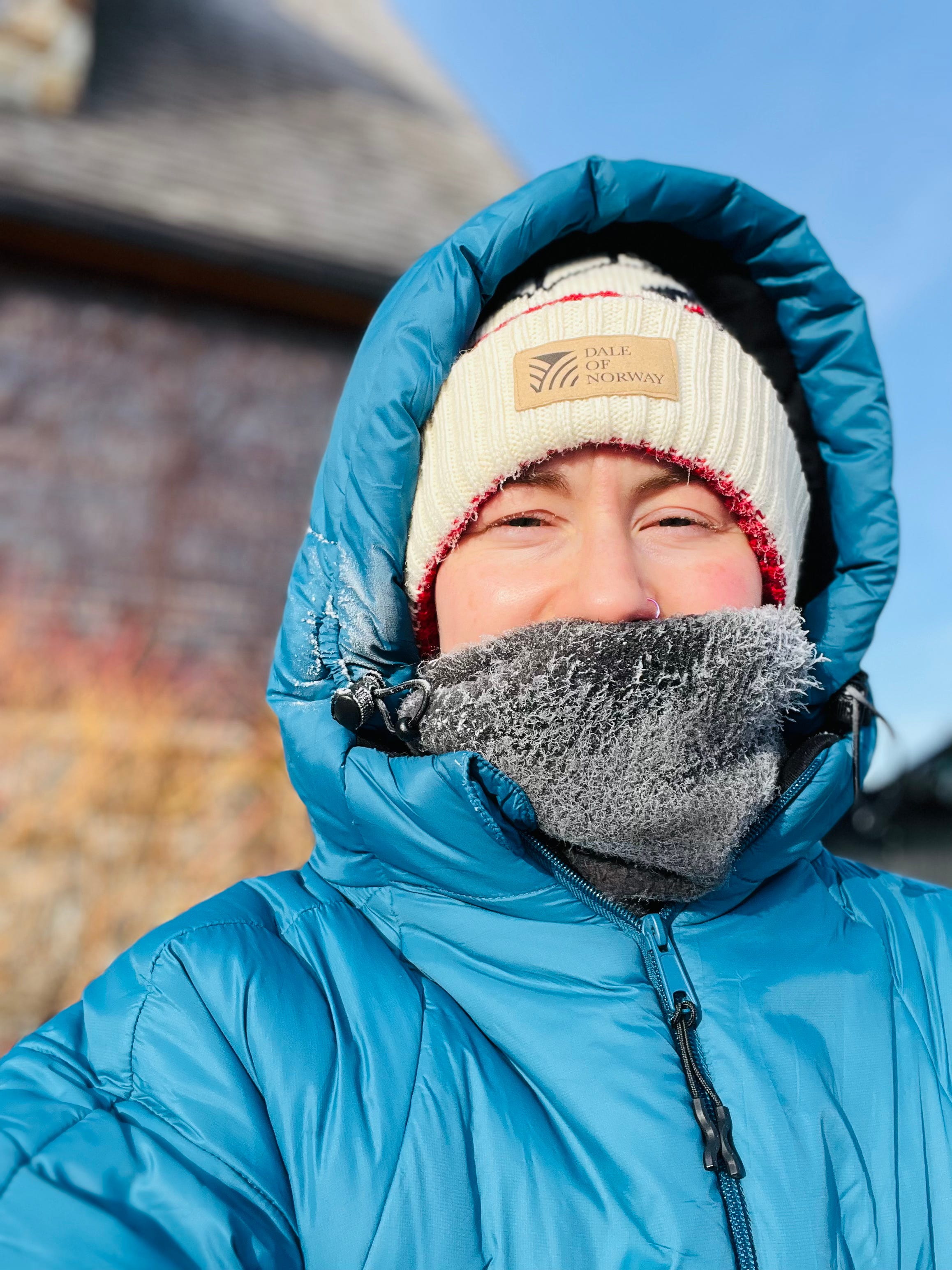
The friluftslive North Star: “There’s no bad weather, only bad clothing.” So get outside and get some fresh air.
More to come on friluftsliv and how we can embrace its praxis, whether you live in a cold climate or not.
May you continue wintering well as we transition into spring.
Thanks for reading!
~Alicia


Reader Interactions